Listen to the Podcast episode here on Spotify

Hidden deep within the Freetown State Forest, the Assonet Ledge rises nearly 60 feet above a dark, water-filled quarry—a place where history, legend, and tragedy intersect. Long before ghost stories and whispered warnings, this land was considered sacred by the Wampanoag people, who lived throughout the region before English colonization.
As Puritan expansion pushed deeper into southern Massachusetts, much of this land was purchased from local tribes—but not without resistance. Some legends claim those who opposed the sale cursed the forest, ensuring unrest would linger long after the ink dried. Whether curse or coincidence, Freetown State Forest has since become one of the most infamous and haunted locations in New England.
Ancient Legends and Dark Beginnings
Adding to the unease are stories of Pukwudgies—small, humanoid tricksters from Algonquian folklore. Once said to coexist peacefully with native tribes, these beings allegedly turned hostile after being betrayed by humans. Legends warn that Pukwudgies lure people into the woods, over cliffs, or into deep water—never to be seen again.
In the 1800s, Assonet Hill was quarried for granite. One account describes an explosion gone wrong, killing five workers, deepening the area’s grim reputation. Some believe the granite itself carried something dark with it. Buildings constructed from Assonet stone—including Taunton State Hospital and Fort Adams in Newport—have both developed reputations for hauntings, despite Fort Adams never seeing wartime combat.
But it’s what happens at the ledge itself that continues to trouble visitors.
The Lady of the Ledge
Over the years, reports have surfaced of people jumping—or being pulled—from the Assonet Ledge. Numbers vary wildly, from a single confirmed death in 2004 to whispers of as many as 18 lives lost. All of this leads to the most well-known spirit associated with the area: The Lady of the Ledge.
Her story is not found in records, only in retellings.
Most versions place her in the mid-20th century. A young woman meets her lover in secret atop the ledge, away from judgmental eyes. When they decide to run away together, they plan one final meeting at their hidden spot. She arrives. He never does.
Realizing she’s been abandoned—and that the life she dreamed of will never come—she steps to the rocky edge and leaps.
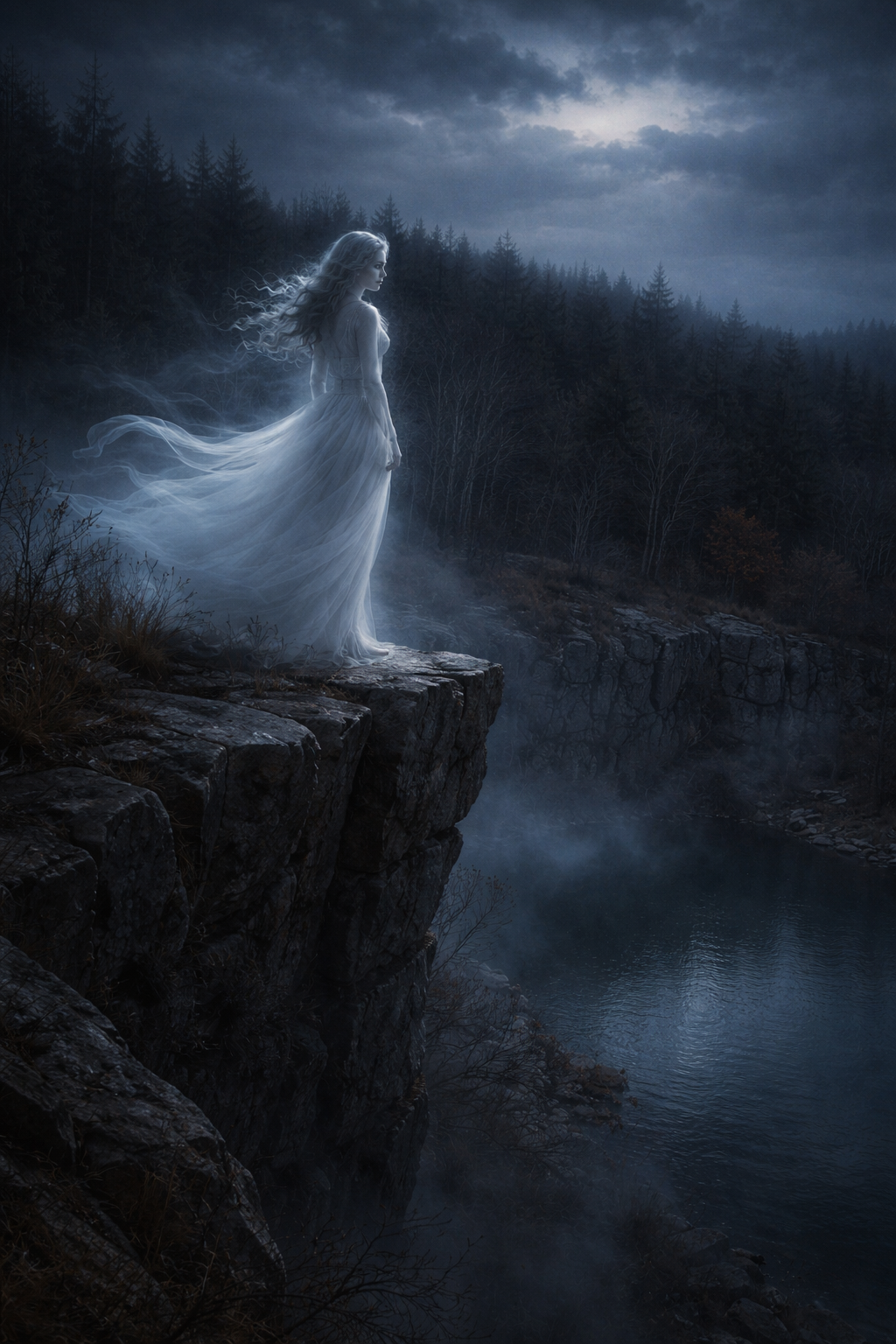
Locals claim her spirit still appears, dressed in white, standing silently at the precipice.
A Witness Account
Paranormal investigator Matt Moniz of Spooky Southcoast Radio shared his own encounter. While visiting the ledge with friends, he was allowed to walk ahead. As he reached the outcropping, he saw a woman standing on the edge.
He turned to warn his friends.
When he looked back—she was gone.
Assuming the worst, he ran to the cliff and looked down. No body. No movement. His friends weren’t surprised.
“Oh,” they told him casually. “You saw the Lady of the Ledge.”
A More Sinister Presence?
What makes this legend especially unsettling is how often visitors report overwhelming urges to jump, feelings of despair, or hearing voices. In the 2004 case, witnesses claimed the victim was happy, engaged, and visiting with family—yet murmured that he didn’t want to jump and felt pulled toward the edge.
One woman reported seeing lights beneath the quarry water, rising toward the surface, beckoning her closer—before being dragged back down.
Another account describes authorities pulling both a body and a car from the quarry in 1977, officially labeled an accidental drowning. The witness found that explanation impossible.
So the question remains:
Is the Lady of the Ledge causing these tragedies?
Or is she herself a victim of something older… darker… and still watching?
Nancy Barton: Love Lost in the White Mountains

Our next story carries us north, along the Saco River, through the icy corridors of Crawford Notch, New Hampshire.
In the late 1700s, Nancy Barton worked as a cook and servant for Colonel Joseph Whipple in Jefferson, New Hampshire. She was known for her diligence and thrift, saving every penny toward a future she planned with a farmhand named Jim Swindell.
They dreamed of marriage. Of Portsmouth. Of escape.
But in the winter of 1778, while Nancy was away, Colonel Whipple—an ardent supporter of the Revolutionary cause—convinced Jim to enlist. Jim took Nancy’s entire life savings, purchased a uniform, and headed south.
When Nancy learned of the betrayal, she didn’t hesitate.
She packed lightly and followed Jim’s trail into the wilderness—over 20 miles, through deep snow and bitter cold. Along the way she found a recently extinguished campfire. Believing she was close, she pressed on.
At a brook crossing, her clothes became soaked. Exhausted, she sat down to rest.
She never got back up.
A search party followed her tracks and found Nancy frozen on the bank. She was buried where she fell. Today, Nancy Brook, Nancy Pond, and Mount Nancy bear her name.
Hikers still report hearing laughter, sobbing, and footsteps along the trail. Some say she’s still searching for Jim.
Legend says Jim later suffered a psychotic break from guilt and died in a psychiatric hospital—never finding peace.
Hannah Robinson: A Life Claimed by Love
Our final story brings us to South Kingstown, Rhode Island, overlooking Narragansett Bay.
Hannah Robinson, born in 1746, was the daughter of wealthy landowner Rowland Robinson Jr. Beautiful, educated, and privileged, Hannah’s future seemed assured.
As a child, she loved to sit on a large cube-shaped rock overlooking the bay—a place of quiet dreams.
At a finishing school in Newport, Hannah fell in love with Pierre Simond, a French and dance instructor. Her father disapproved. Pierre lacked wealth and status.
The two met in secret.
Eventually, they eloped to Providence and married.
Reality arrived swiftly.
Cut off financially, Hannah watched as Pierre’s devotion faded. Affairs followed. Then abandonment. She was left impoverished, sick, and broken.
Only when Hannah was near death did her father relent. He came to bring her home.
On the journey, Hannah asked for one final stop—at her beloved rock.
She sat there, gazing over the bay.
She died shortly after, at just 27 years old, on October 30, 1773.
Today, that spot is marked by the Hannah Robinson Tower on Tower Hill Road. Originally built in 1938 by the Civilian Conservation Corps as a WWII observation tower, it still overlooks the bay—standing as a silent monument to a love that cost everything.
Tragic Love Never Truly Dies
From Assonet Ledge to Crawford Notch to Narragansett Bay, these stories share a common thread:
Love that burns too fiercely, ends too tragically, and refuses to rest.
And if you visit these places—
Mind the cliffs.
Mind the cold.
And listen carefully.
Some stories don’t want to be forgotten.
