
When I sat down to record an episode with Connecticut horror author Tristan Mason, I wasn’t sure what to expect. Tristan reached out as a fiction writer drawing inspiration from New England folklore, and his stories—especially those involving the Black Dog of the woods and the Voluntown Vampires—immediately caught my attention. His upcoming book, Nutmeg Horror, leans heavily on real places and real legends, the kind that linger just beneath the surface of everyday life.
What I didn’t expect was that one of his stories would push me out the door and into a real-world adventure—straight to Charles Island, just off the coast of Milford, Connecticut.
Discovering Charles Island
I’d heard of Charles Island before. Most people have. A cursed island. Pirate treasure. Captain Kidd. A land bridge that appears and disappears with the tide. But like many local legends, it lived in the abstract for me—interesting, but distant.
That changed when I saw a social media post from Tristan. He and his wife were standing on what looked like an ordinary beach. Behind them, just offshore, was a small, tree-covered island. The caption mentioned Charles Island, Captain Kidd, and Milford, CT.
That’s when it clicked.
Milford is only about a 90-minute drive.
A few weeks later, my schedule and the tides finally lined up.
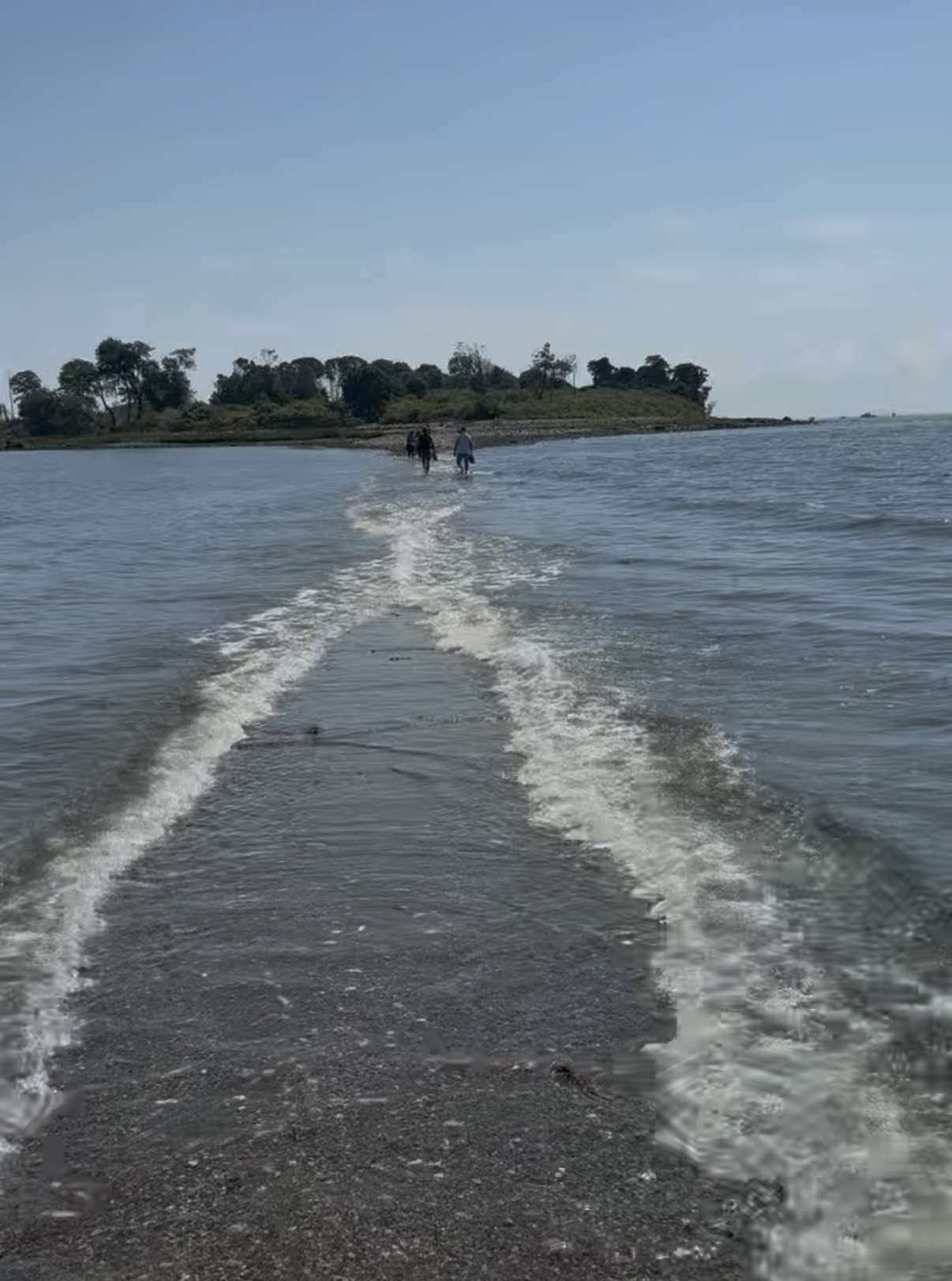
Crossing the Tombolo at Silver Beach
Charles Island is accessible via a tombolo, a natural sandbar that connects the island to Silver sands Beach during low tide. I planned my visit carefully, arriving about an hour before dead low tide to give myself enough time to explore the island’s 14 acres before the water returned.
From the shore, the island looks deceptively close. Several groups were already making the crossing when I started out. About a quarter of the way across, the sand narrows, turns rocky, then becomes a mix of shells and shallow water. At some point, you realize the term “land bridge” is generous—you’re getting wet.
Most people stopped to remove their shoes. I didn’t. If I was committed to walking to an island, I figured wet sneakers were a fair price. That decision paid off. While others carefully picked their way across slick stones, I moved steadily through ankle-deep water. The crossing is just over half a mile.

Exploring a Cursed Island
Once on Charles Island, I was surprised by how large it felt. I followed rough, brush-cut trails into the interior, some fenced off to protect bird habitats. An osprey nest sat atop a tall pole near the island’s highest point.
Near the center of the island, I stumbled across something unexpected: a stone well, partially hidden in the path. It was similar to wells I’ve seen near abandoned colonial sites, like Pilfershire CT—silent evidence that people once lived and worked here.
Further in, I found old stone foundations, nearly swallowed by new growth. These weren’t official hiking trails; they were maintenance paths cut through dense brush to service the bird sanctuary. It made me wonder how crews even manage to get heavy equipment out here.
On the far side of the island, a large area of underbrush had been flattened. Whether it was routine maintenance or something more purposeful, I couldn’t help but wonder.
I circled the island, alternating between rocky shoreline and overgrown trails, taking in sweeping views of Long Island Sound. At one point, curiosity pulled me into a narrow opening in the brush—but it quickly became impassable, thick with briars. Some places are clearly meant to stay hidden.
The Tide Comes Back
As I headed back toward the tombolo, the tide had already begun to rise. Waves crossed from opposite directions, creating unpredictable currents. I passed park rangers heading out to warn visitors that the crossing was closing.
Back at my Jeep, shoes soaked and socks wrung out, I sat for a moment reflecting on what I’d just done—walked across a disappearing bridge to a thrice-cursed island and made it back safely.
The First Curse: The Paugusset Tribe
Before English colonists arrived, the area now known as Milford was home to the Paugusset Tribe. Charles Island was originally called Poquahaug, possibly meaning “cleared land.” Historians believe the tribal chief, Asantewaa, used the island as a summer home.
In 1639, English settlers purchased Milford—including the island—for what today would be considered a shockingly small price: coats, blankets, tools, and mirrors.
Legend says Asantewaa later regretted the sale and cursed the island so that anything built there would burn. Another version claims the curse was placed after his daughter was kidnapped—an accusation that, historically, rarely ends well for colonial settlers.
The Second Curse: Captain Kidd’s Treasure
The second curse is tied to Captain William Kidd, the infamous pirate—or privateer, depending on who you ask. Kidd was commissioned in 1695 to hunt pirates, but his voyage spiraled into mutiny and controversy.
In 1698, Kidd captured the Quedagh Merchant, an Armenian-owned ship. He returned to Boston seeking legal protection but was arrested and sent to London, where he was executed in 1701. Famously, the gallows failed the first time.
Before his arrest, Kidd buried treasure along the coast. Charles Island is one of the suspected locations, alongside the confirmed cache on Gardiner’s Island.
The Third Curse: Aztec Gold
The final curse reads like a legend straight out of a pirate movie.
In 1721, five sailors reportedly discovered gold hidden in a Mexican cave—treasure once belonging to Cuauhtemōc, the last Aztec emperor. After fleeing to Milford, four of the sailors died violently. The last survivor hid the remaining treasure in a tavern basement before rowing it to Charles Island and burying it under cover of darkness.
Fires, Failures, and Abandonment
Over the centuries, every major attempt to develop Charles Island has failed.
A grand mansion built in the 1800s burned down.
A Dominican friars’ retreat from the 1930s was abandoned.
Ideas for amusement parks—even a nuclear facility—never came to fruition.
Today, Charles Island is managed by the Connecticut Department of Energy and Environmental Protection and serves as a protected bird sanctuary, home to herons and egrets. It’s recognized by the National Audubon Society as an Important Bird Area.
Visiting Charles Island Today
The island is closed during nesting season in spring and summer, but when it’s open, visitors are welcome—so long as they respect the wildlife and the tide.
People often report feeling watched on Charles Island. It’s probably nothing.
But if you do visit, my advice is simple:
Leave any gold you find. And mind the tide.
Read about the History of Charles Island here.
Read the true story Of Captain William Kidd here.

