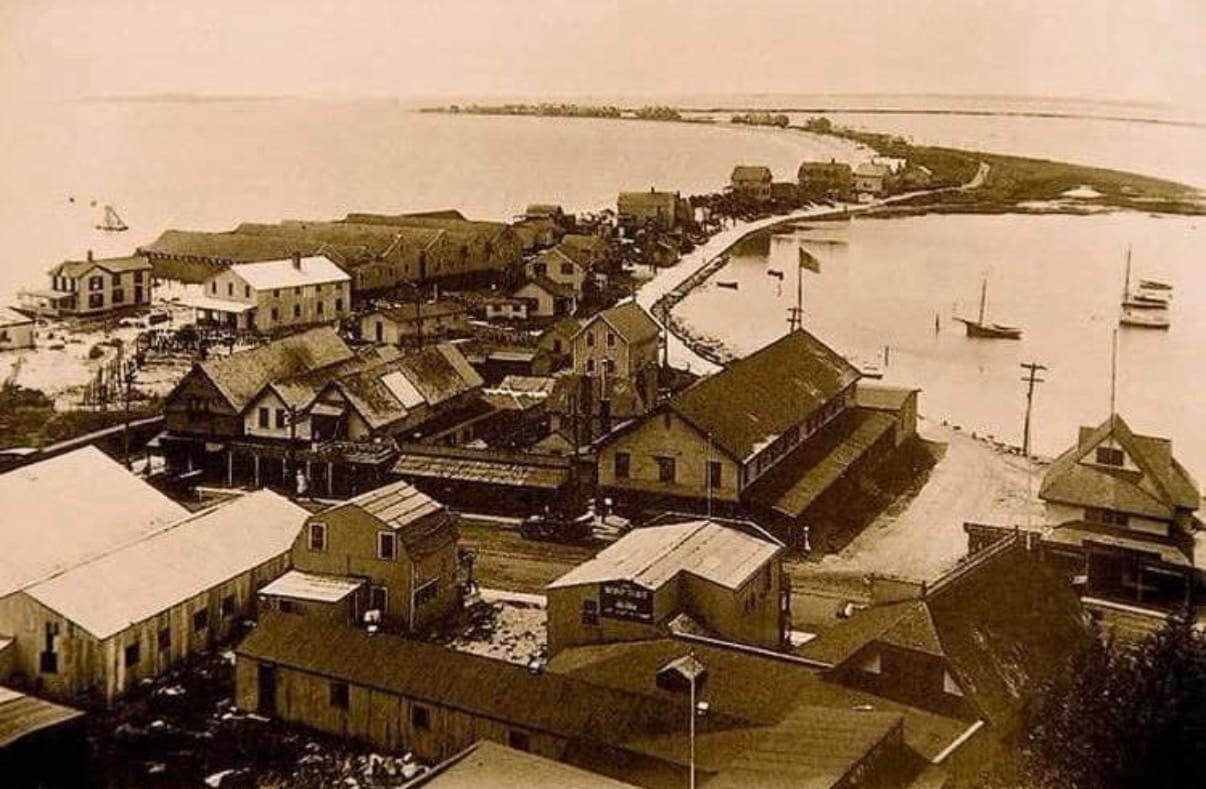

Perched at the southwestern most edge of Rhode Island, Watch Hill has long been a place of strategic importance, sweeping ocean views, and layered history. On a clear day, the Atlantic horizon stretches from Block Island all the way to Montauk, a vantage point that made this land valuable long before modern warfare ever reached its shores.
Hidden along the sands of Napatree Point lie the eroding remains of Fort Mansfield, a forgotten piece of America’s coastal defense system and a silent witness to war planning, natural disaster, and the relentless pull of the sea.
Strategic Ground Before the Fort
Even before European colonists arrived, the Niantic tribe understood the importance of this land. Its elevated position and unobstructed views of the Atlantic made it ideal for spotting threats approaching from the sea.
During the French and Indian War and later the American Revolutionary War, Watch Hill’s prominence earned it its name. It became a natural lookout over Fisher’s Island Sound and Long Island Sound, a role it would continue to play well into the late 19th century.
Watch Hill’s Historic Landmarks
Today, Watch Hill is better known for its iconic landmarks:
- Watch Hill Lighthouse (originally built in 1774)
- Flying Horse Carousel, the oldest operating suspended horse carousel in the United States
- Ocean House, a grand Victorian hotel overlooking the sea
But unlike these well-preserved icons, Fort Mansfield existed solely for one purpose: defending the coastline.
The Construction of Fort Mansfield
Built in 1889 following the recommendations of the Endicott Board, Fort Mansfield was part of a massive network of coastal defenses stretching from Maine to Texas. Initially intended as a satellite installation supporting Fort Trumbull, the fort eventually became an independent artillery battery once fully staffed.
Fort Mansfield played a role in the coastal defense of Long Island Sound and was designed to help protect New York City from naval attack.
Batteries and Armament
The fort consisted of three main gun batteries:
- Battery Crawford – located at the tip of the point, armed with two 5-inch M1897 guns
- Battery Wooster – nearby, housing two 8-inch M1888 guns
- Battery Connell – closer to the shoreline, equipped with two 5-inch M1900 guns
The fort reached full garrison strength in 1901, but its operational life would be short-lived.
The Fatal Design Flaw
During a 1907 war game, military planners discovered a critical weakness in Fort Mansfield’s layout: a “dead angle.” From the eastern approach, the water was deep enough to allow an enemy destroyer to pass through, yet the fort’s guns were unable to fire on that area.
This single flaw rendered the fort strategically ineffective.
By 1909, Fort Mansfield was removed from the list of active coastal artillery posts. It was placed into caretaker status, staffed by just 18 men by 1911, and reduced to only six personnel by 1916. In 1917, the fort’s guns were removed, potentially for use on the Western Front during World War I.
Abandonment and Private Ownership
The U.S. government maintained a minimal presence at Fort Mansfield until 1927, when the land was sold to a private syndicate. The goal was not redevelopment, but preservation—preventing Watch Hill from being subdivided into inexpensive housing and maintaining its exclusivity.
All remaining military structures were demolished during the winter of 1928–1929, leaving behind Fort Road as the only connection to the abandoned site.
The 1938 Hurricane and Napatree Point
Homes were eventually constructed along Fort Road on Napatree Point, though records are unclear on exactly how many. When the New England Hurricane of 1938 struck, 42 residents were present.
The storm proved catastrophic.
Fifteen people lost their lives when buildings were swept off the narrow sandbar. Others survived only by clinging to debris as the surge tore through the area. The hurricane destroyed:
- Fort Road
- 39 homes
- The yacht club
- The beach club
- A bathing pavilion
A Landscape Reclaimed by Nature

Since the mid-1930s, the shoreline has retreated by approximately 200 feet. What was once a sandy extension of the Napatree Peninsula is now effectively an island. Today, the land is protected as a wildlife preserve and public beach, managed by the Watch Hill Conservancy and Fire District.
The remains of Battery Wooster and Battery Crawford are still accessible and slowly eroding into the dunes. What’s left of Battery Connell occasionally appears at low tide, its structure now partially submerged beneath the waves.
The Greater Coastal Defense Network
Fort Mansfield was just one part of a much larger system of coastal fortifications across southern New England:
- Fort Trumbull – preserved
- Fort Griswold – preserved as a park
- Fort H.G. Wright – partially derelict, partially repurposed
- Fort Terry – derelict; later used for biological research
- Fort Michie – derelict, owned by the American Museum of Natural History
- Fort Tyler – derelict bird sanctuary; landing prohibited
- Camp Hero – preserved state park, infamous for the Montauk Project legends
A Vanishing Fort
Today, Fort Mansfield exists in fragments—crumbling concrete, buried gun emplacements, and stories slowly fading into the sea. It stands as a reminder that not all defenses fail because of battle. Sometimes, a fort is defeated by design flaws, shifting priorities, and the unstoppable force of nature itself.
For those willing to walk the sands of Watch Hill and Napatree Point, Fort Mansfield is still there—quiet, eroding, and waiting to be remembered.


