Exploring the Bridgewater Triangle: The Mystery of Dighton Rock
I decided to take a ride and spend some time in the Bridgewater Triangle, visiting places I’d heard of for years but never explored myself. I’d already been to familiar landmarks like the Assonet Ledge, the pet cemetery, and Copicut Road—places I used to visit long before I knew there was anything paranormal about them. Anawan Rock was another accidental visit while driving through Rehoboth for work. Then there were darker spots like Mary Lou Arruda’s tree and the remnants of the infamous “murder cabin.” But there was one place that kept coming up in my research and in a fictional podcast I’d listened to years ago: Dighton Rock.
The Mystery of Dighton Rock
In that podcast, the host described Dighton Rock as a strange, powerful relic—etched with mysterious carvings that some say hold otherworldly energy. The character even described the rock as hot to the touch. Those days are long gone; much like Plymouth Rock, you can no longer touch it—only view it behind glass. Still, the intrigue surrounding this massive 40-ton sandstone boulder endures.
Whenever the Bridgewater Triangle comes up, the conversation inevitably turns to the paranormal and the unexplained. We talk about the colonists and the Wampanoag tribe, King Philip’s War, and the blood-soaked history that still lingers in the land. The story of Dighton Rock fits neatly into that tradition of mystery.
The English first recorded Dighton Rock in 1680, though many believe its markings are far older—perhaps even ancient enough to rewrite American history as we know it.
Geography of the Triangle
Dighton Rock sits along the banks of the Taunton River in modern-day Berkley, Massachusetts. Its placement in the Bridgewater Triangle seems almost intentional. Imagine the Triangle as an isosceles shape—its long sides stretching from Freetown State Forest on the lower right to Rehoboth on the lower left, and the Hockomock Swamp forming the upper tip. The Taunton River cuts through the middle, and roughly one-fifth of the way up—there it is: Dighton Rock, right at the heart of it all.
The Hockomock Swamp alone spans nearly 17,000 acres, forming a major part of the Taunton River watershed—the largest contained entirely within Massachusetts. Its Algonquin name means “where the spirits dwell,” and that sense of mystery seems to flow downstream to Dighton Rock, whose carved face was once visible only for a few hours each day at low tide.
The First Records and Early Theories
The first recorded sighting came from Harvard graduate Reverend John Danforth in 1680. (Yes, Harvard existed that early—founded in 1636 and renamed in 1639 after its first benefactor, John Harvard.) Danforth made a detailed drawing of the markings, now housed in the British Museum. He believed the carvings depicted a ship battling with Native people—a tale he’d heard from local tribes.
Nine years later, Cotton Mather mentioned Dighton Rock in a sermon titled The Wonderful Works of God Commemorated (1689). Mather suggested that explorers, guided by Satan himself, came to the New World before the Puritans and met a tragic fate—a story eerily reminiscent of the lost Roanoke colony.
In 1767, Yale President Ezra Stiles proposed that the carvings were Phoenician in origin. The Phoenicians were ancient seafarers from the Mediterranean—modern-day Lebanon, Syria, and Israel—whose trade routes connected the Old World thousands of years before Columbus. Could they have crossed the Atlantic and left their mark on this boulder in Massachusetts?
Even George Washington weighed in. During a New England tour in 1789, he concluded that the markings looked Native American, similar to others he’d seen in Virginia.
Norse and Portuguese Theories
In 1837, Danish scholar Charles Christian Rafn reignited the debate, arguing that the inscriptions were Norse. He claimed to read the words: “Thorfinn and his 151 companions took possession of this land.” Rafn believed Vinland—the legendary Viking settlement—was in New England, and that Norse explorers had reached Massachusetts centuries before Columbus.
In 1912, Edmund Burke Delabarre presented a new theory: the carvings were Portuguese. He interpreted the markings as reading: “I, Miguel Corte-Real, 1511. In this place, by the will of God, I became a chief of the Indians.” Corte-Real was a real Portuguese explorer who vanished during an expedition in 1502. Could he have survived and settled here along the Taunton River?
The Rock Today
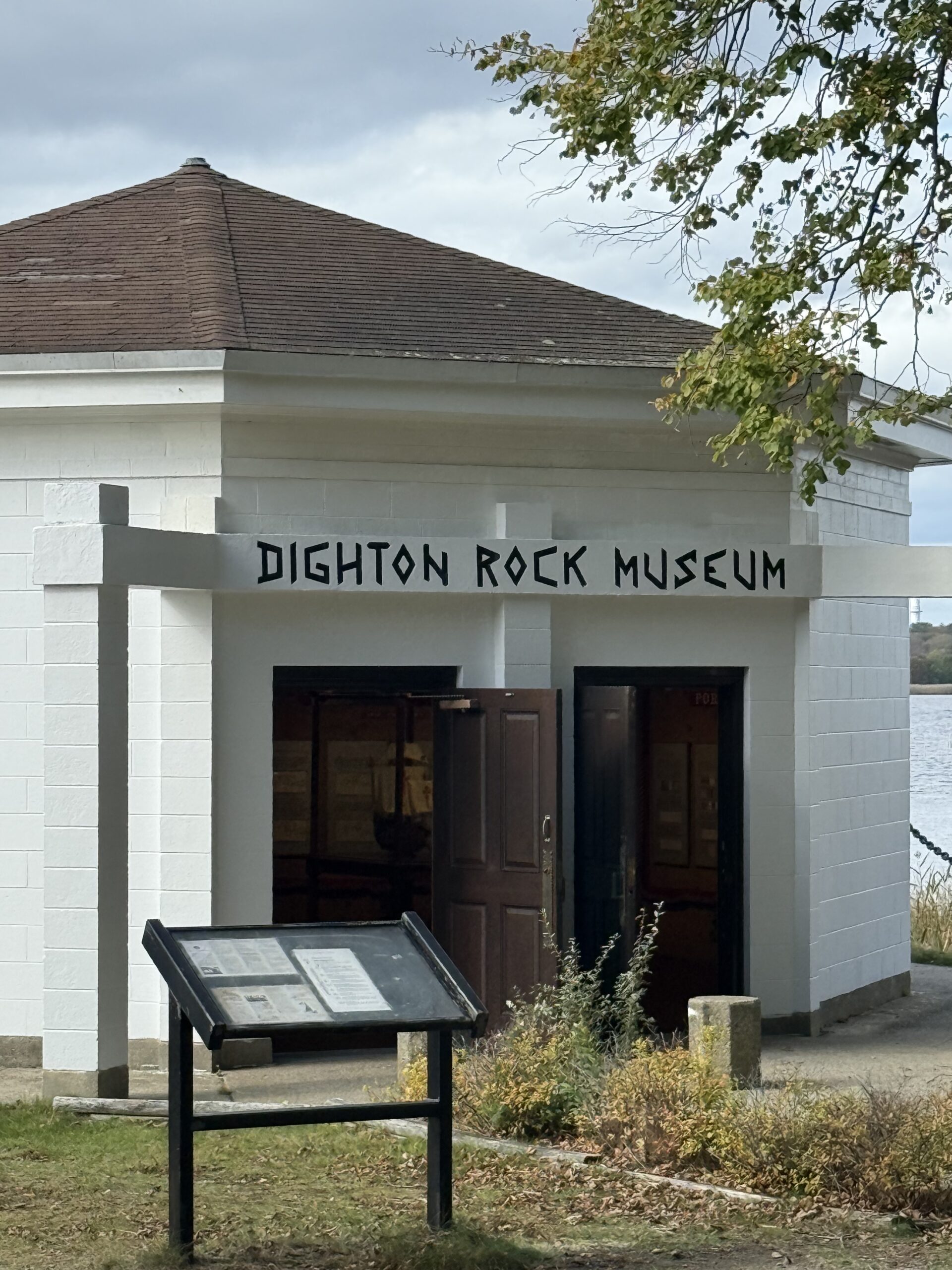
In 1963, Dighton Rock was removed from the river and placed safely within Dighton Rock State Park, where it rests inside a small museum overlooking the Taunton River. The first room of the museum details the rock’s long history and the many theories about its mysterious markings. The second room houses the rock itself—encased in plexiglass but still commanding attention.
Outside, the park’s 85 acres offer scenic trails, stone walls, and even a small cemetery hidden among the trees. The riverbank provides a peaceful view that contrasts sharply with the centuries of speculation surrounding the rock.
A Mystery Set in Stone
Dighton Rock stands as one of New England’s great unsolved mysteries—a stone covered in cryptic symbols that seem to whisper stories from across time. Whether those carvings were made by indigenous peoples, lost explorers, or ancient visitors from distant lands, one thing is certain: the Bridgewater Triangle holds its secrets close, and Dighton Rock remains at the center of its enduring enigma.


