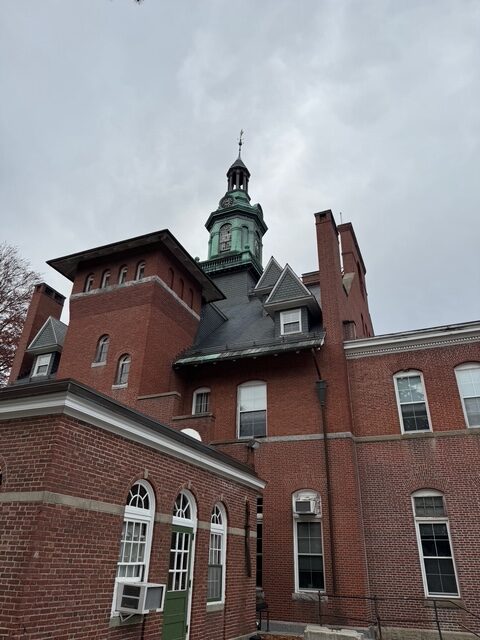
If you wind your way down the quiet roads of Tewksbury, Massachusetts, and slip past the rolling fields and red-brick buildings of the state hospital grounds, you may feel it—that subtle shift in the air, the faint hum of history lingering just beneath the ordinary. Tewksbury State Hospital is one of those places where the past doesn’t feel gone. It feels stored, preserved… or perhaps restrained.
This is a place with a long memory.
A place shaped by suffering, resilience, and whispered stories passed from one generation to the next.
And by the end of this tale, we will walk together into the pine woods, where the dead lie in silence—and where some say silence is not the only thing that lingers.

The Origins: A Solution to a Growing Crisis
The story of Tewksbury begins in the mid-19th century. The industrial revolution had transformed Massachusetts—textile mills roared, cities swelled, and immigration surged. With this growth came overcrowding, poverty, and a heartbreaking level of homelessness. Almshouses struggled to keep up, and concern grew for the mentally ill, the chronically sick, and the destitute.
In 1852, the Massachusetts legislature acted, authorizing the construction of a “state almshouse” in Tewksbury. Transportation was simple—the site was located along the new railroad line. But the real reason for choosing Tewksbury was far less glamorous: the land was cheap, remote, and easy for the state to control.
By May of 1854, the State Almshouse at Tewksbury opened its doors.
Within weeks, over 800 people crowded into the facility—mostly impoverished immigrant families, orphans, new mothers, and the chronically ill. Many of them had nowhere else to go.
It was meant to be a refuge.
But like many institutions of the era, Tewksbury found itself walking a thin line between sanctuary and containment.

A Growing Institution with a Darkening Reputation
The almshouse grew quickly, adding new wards for the sick, the mentally ill, the elderly, and the physically disabled. By the 1870s, Tewksbury had become one of the largest public institutions in New England.
But size brought scrutiny.
The Scandal of 1879
In 1879, Massachusetts Governor Benjamin Butler accused the facility of shocking mismanagement. Among his most sensational claims:
- bodies of deceased patients being sold to medical schools
- lard and tallow rendered from corpses
- cruel and inhumane treatment of residents
- corruption in food and supply contracts
These allegations sparked a massive statewide scandal. Investigations swirled for months. Though the committee eventually dismissed most of Butler’s accusations as exaggerated or unfounded, the damage was done. Tewksbury became a place associated not just with care—but with controversy.
Yet, it continued to grow.

Transformation Into a State Hospital
By the late 19th century, the almshouse evolved again. Massachusetts recognized the need for more specialized medical care, and Tewksbury shifted toward a hospital model.
In 1895, the almshouse officially became Tewksbury State Hospital and Infirmary.
At its height, the complex had:
- a massive central administrative building
- tuberculosis wards
- wards for the mentally ill
- a working farm
- a nursing school
- dormitories and children’s facilities
- its own fire department and power plant
It was, in essence, a small city—home to thousands of residents and staff. Many lived their entire lives within its borders. Many more died there.
And that brings us closer to the shadows.

The Forgotten Cemetery System
Across the hospital grounds lie several burial sites—simple, quiet places often unnoticed by visitors. Many of the dead were patients who had no family, no money, or no one willing to claim their bodies.
They were buried with little ceremony.
Often with only a number.
Sometimes with nothing at all.
The most mysterious of these burial places is tucked away beneath tall white pines, well off the main road:
The Cemetery in the Pines.
But we’ll get there soon.
The Patients: Lives of Hardship and Hope
The population at Tewksbury spanned every category the state struggled to support:
- immigrants
- orphans
- the elderly poor
- the mentally ill
- tuberculosis patients
- alcoholics
- victims of workplace injuries
- unwed mothers
- veterans
- the chronically handicapped
Conditions varied over the decades. Some periods saw compassionate care and dedicated nurses; others were plagued with overcrowding, understaffing, and primitive medical knowledge.
Tuberculosis, in particular, ravaged the patient population. Entire wards filled with men and women coughing through sleepless nights, waiting on the next roll of the oxygen cart or the next experimental treatment.
Many of them never left.

The Hospital Through the 20th Century
When the Great Depression hit, Tewksbury once again overflowed with the displaced and the desperate.
During both World Wars, the hospital cared for veterans suffering from injuries, trauma, and illnesses. After the wars, advances in medicine changed the facility’s role—it became more specialized, focusing on chronic diseases, rehabilitation, and long-term psychiatric care.
By the 1960s and 70s, deinstitutionalization began emptying many state hospitals, but Tewksbury survived by shifting toward long-term medical care rather than psychiatric confinement.
Today, the hospital remains open, serving patients with chronic and complex medical needs. But its past—its long, difficult, and sometimes tragic history—has never truly faded.
And in the pine woods, that past feels closer than anywhere else.
The Cemetery in the Pines: A Place Where the Dead Still Whisper
Walk far enough into the back trails of the hospital grounds and eventually, the forest grows strangely quiet. Long rows of towering pines close in overhead, their needles softening every footstep. It is here, beneath these trees, that the most haunting chapter of Tewksbury’s story lies.
A Field of Numbered Graves
The Cemetery in the Pines contains over 10,000 burials, though no one knows the exact number.
The graves are simple.
Unadorned.
Most marked only by:
- a small concrete block
- stamped with a number
- sometimes partially sunken or lost under decades of leaf litter
The people buried here were once residents of the hospital—patients who died alone, or whose families couldn’t afford burial, or who had no family left at all.
From the 1800s through much of the 20th century, this quiet grove became the final resting place for thousands of forgotten lives.
And these forgotten lives have birthed the legends.
Ghost Stories of the Pines
People who wander through Cemetery in the Pines often speak of strange sensations—an oppressive weight in the air, a sudden chill even on hot summer days, the dizziness that comes from walking on ground that feels alive beneath the surface.
Here are the stories that echo through the forest:
1. The Whispering Wind
Visitors frequently report hearing low voices drifting between the trees—whispers too soft to comprehend, but unmistakably human. Some say they sound like prayers. Others say they sound like weeping.
In every case, the moment you stop walking…
the voices stop too.
2. Shadow Figures Among the Pines
Hikers sometimes glimpse figures standing between the trees—dark silhouettes that resemble men in hospital gowns, women in long dresses, nurses in old-fashioned caps.
They vanish when approached.
Some disappear the moment you blink.
Hospital staff who walk the grounds at night have reported seeing movement along the tree line, even when security swears no one else is out there.
3. The Feeling of Being Followed
Many investigators say the same thing:
You never walk alone in the Pines.
Soft footsteps trail behind visitors. Twigs snap just out of sight. And in the stillness, there’s a presence—watching. Waiting. Moving when you move.
Paranormal teams have captured EVPs of footsteps, sighs, and a faint, desperate “Wait…” recorded on more than one occasion.
4. The Child Spirit
Some locals believe a child spirit lingers here, based on EVPs, small shadows seen darting behind gravestones, and the odd sound of a giggle or a sob carried on the wind.
The cemetery holds the graves of orphans, abandoned children, and infants who died in the hospital’s early years.
Their stories, like their names, were lost.
5. Lights in the Woods
One of the most frequent reports involves pale, drifting lights weaving between the pines—sometimes blue, sometimes white, occasionally a faint green glow. They move slowly, almost curiously, and vanish when approached.
Skeptics blame fireflies.
Anyone who has seen them swears they are something far more deliberate.
Why the Pine Cemetery Feels So Haunted
Some say it’s the sheer number of burials.
Others say it’s the unmarked graves.
Still others point to the emotional weight of the hospital’s past.
Tewksbury was a place where:
- the sick came to die
- the forgotten were buried
- families left loved ones and never returned
- thousands lived in despair or isolation
- suffering became routine
- anonymity was common
- hope was often thin
That kind of pain leaves a mark.
And the land remembers.

A Place Where History and Haunting Intertwine
Today, the grounds of Tewksbury State Hospital are peaceful. Staff go about their work. Patients receive care. The buildings stand tall—some renovated, some still echoing with the architecture of the past.
But the woods, especially the Cemetery in the Pines, retain a strange, heavy stillness. A reminder that history lives not only in books, but in the very earth beneath our feet.
If you visit respectfully, walk softly.
Move slowly.
Listen between the trees.
The people who lived and died here may have been forgotten by the world—but in the whispering pines of Tewksbury, they are anything but silent.


